Marion’s Legacy
Wow – what an incredible reach to our post on 22nd January about our Herd Matriarch, Marion’s, final journey from our farm with an unanticipated reach of 186000 views and counting. Understandably, an emotive point of discussion with a variety of views/interpretations expressed in the comments. Of course everyone is entitled to their personal opinion.
Those who have been following our social media pages for a while will be familiar with our open approach documenting our day to day work here on the farm, what’s happening and why, all of which is fundamental to our “farm to fork” ethos. Afterall, we are farmers and we are here to do our bit to produce food for the population. Of that population, individuals can choose what type of food they are going to put on their plates on the basis of what is best suited to their tastes, restrictions, lifestyles and personal beliefs, budgets etc… Over the last 50 years there has been increasing disconnect between “farm and fork” as end consumer becomes further removed from food production process with increasing automation in all industries. We share what we do and why on the farm because it is our belief that we should all know and understand where our food (one of our most basic needs) comes before it is packaged up ready to eat . We were asked in the comments “if the intention of our post was to paint farmers in a good light because if so, it failed”. No our intention was to document what was a real life significant event for us.
If you are catching this for the first time our Beef Shorthorn cross cow, Marion, was recently sold at the market, at the age of 14 having been a wonderful cow here. She was the first cow to arrive on our farm after we started our farming journey here. In fact, she was bought by Farmer G as an in-calf heifer for myself as a wedding present. Back story being I am the 4th daughter in a family of beef and sheep farmers and my Dad had teased Gordon that we weren’t on a real farm until we had a cow. As we all know Gordon was always going to make it a “real farm” as cattle were always his goal though perhaps not initially of the beefier type.
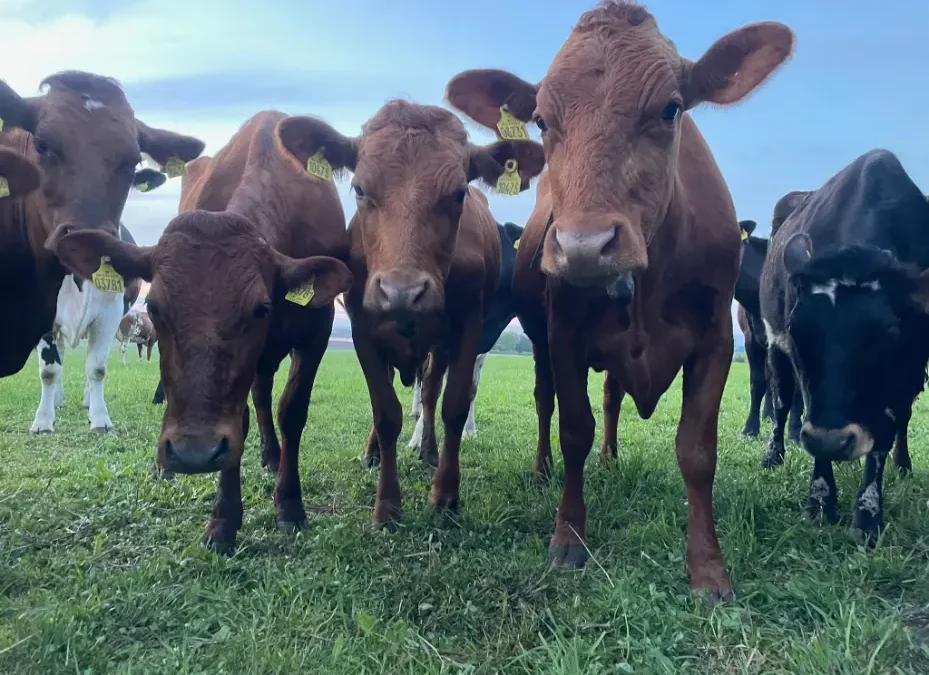
We will remember Marion fondly – she was a feisty red head and lived her reign here as Queen Bee of the herd. She proudly reared a calf every year delivering them without assistance – with the exception of her very first calf when she decided she didn’t fancy having her calf in her field and opted to jump the fence, cross the barley that was beginning to emerge through the ground and seek shelter in the neighbouring woodland that was overgrown with gorse 12 years ago and still is today. We had been on the farm less than a year at this point. I was working nightshift in Aberdeen at the time and Farmer G still had hens at the other end of the A96. We were both excited about the imminent arrival of our first calf and on returning from work checked on her laying comfortably in the field just as she was before Gordon left to see to the hens. I remember sorting some housework and prepping our dinner and then thinking I’ll just go check her again before I go to bed… This of course ended up in a search, finding those footprints in the barley that directed me to that gorse filled wood. I can assure you this experience gave me an insight into the advantages of a leather hide… When I found her she was showing signs of starting to calf. I kept her in sight knowing fine well I wasn’t going to persuade her, on my own, to walk back to the farm to the nice sheltered cosy barn space that had been prepared for her and her new arrival and waited for Gordon to return. Between us we got her back to the shed, by this time the feet were visible and the temptation to help too great and after a gentle pull Amber was born – a limousin cross heifer, and we got our first sign of her strong maternal instinct. Mother and calf both did well and on coming into heat and in the absence of a bull on the farm at that time Marion decided to go get one for herself and after another fence jump visited the neighbour and returned in calf to their Simmental bull… Over the following years we added dairy cattle to the herd and Marion was always the boss. Today, we have one of her daughter’s and a grand-daughter and her final son. It was sad to see her get slower and hear her bones creaking as she walked. She could still hold her position with the other cows but with her advancing age we knew that if we kept her here she was at increasing risk of injury from the younger herd. We decided that her last calf was going to be her last, keeping her separate from the our Angus bull to avoid her getting back in calf. Her creaky bones meant that her fence jumping days were behind her so we definitely wouldn’t be doing the drive of shame to our neighbour to collect her.
Clearly, during her time with us, Marion contributed significantly to our farm and in our opinion lived a good life. She was indeed special as the first cow on the farm and also because she was a wedding present and symbolic of starting out our married life together here on the farm. Those vows taken that day “for better for worse, richer for poorer, in sickness and in health until death do us part” are remembered when we are faced with challenges or tough decisions such as this and on Marion’s final journey from the farm we both went with her to the market. There were some comments asking how I felt – red eyed but accepting of the fact it was time.
Our post attracted lots of comments, good, bad and ugly. I have picked out 3 main themes to address.
Why didn’t we just let her live out her natural life on the farm or send her to a sanctuary?
An essay could be written here in itself. If we had kept Marion to live out her natural life on the farm why don’t we keep all our animals to live out their natural lives on the farm or send them all to a sanctuary – after all each have made their contributions too be it for eggs, milk or meat?
Put simply, we have a fixed number of acres and shed space to manage and unfortunately combined with a limited budget made this option unavailable. Someone did comment “money doesn’t buy happiness” and while I wholeheartedly agree with this, it does pay the bills. How are Sanctuaries funded? What is the available capacity? If all these costs were considered what impact would that inevitably have on the price of production of a steak or a kilo of mince?
If we had unlimited resource and were in a position to keep her we would have had to watch her body increasingly fail her with increasing suffering. Marion weighed 610kg at the market for perspective. Think about the practicalities of safely administering long term pain relief. This would be a welfare concern.
Why not have her “put to sleep” on the farm?
Marion was a respected animal but she was not a domestic pet. What would we do with her after she had been “put to sleep”? Unlike domestic pets, we can’t just dig a hole in the garden for burial. Size and time constraints aside this would actually be illegal and instead we would have to have her removed by the fallen stock service which obviously comes with a charge and would have seen her do the rounds with all the dead stock on the rounds to the incinerator. This would not have been a final journey we would have wanted for her. We made the decision to take her to the market while she was still fit to travel.
After her valued contribution why put her to slaughter?
Putting her to slaughter recognises the value that Marion will have in death. Her buyer is going to give her more time with more feed optimising her body ready for slaughter i.e. fattening her up. I am sure she will enjoy that. Yes, we got some money back from Marion by selling her at the market but this was not simply a cold cash transaction. At the slaughter house her death will be controlled and quick. In death, there will be more to Marion than simply meat. There will be tallow, leather, collagen for a wide array of supplements (some of which I am of the age I should be considering making use of…), soaps, pharmaceuticals, detergents, compostable “plastics”, lubricants, paints, fertilisers to name but a few – an impressive but not exhaustive list of products we can make use of in our day to day lives with input into wider industries supporting employment etc. Our opinion is that this is a much more fitting destiny for our Queen Bee than turning into ash. Sustainability is at the heart of what we do.
Hopefully, these short answers give some perspective to our decision making. There is a wise saying that if it was easy everyone would be doing it and indeed we consider it (farming) a privilege.
June aka The Wife